
Criminal Court Records in Prince George's County
A criminal court record is the official court file for a prosecution. In Prince George's County, the file may begin in the District Court of Maryland for misdemeanors, traffic crimes, initial appearances, and certain felony matters, or it may proceed in the Circuit Court for Prince George's County when the matter is a felony, jury-trial case, indictment, appeal from District Court, probation violation, or other case within Circuit Court jurisdiction. The Clerk of the Circuit Court maintains Circuit Court criminal files at the Upper Marlboro courthouse, and the District Court clerk maintains District Court criminal and traffic-criminal files at the Upper Marlboro or Hyattsville location that handled the case.
The case file should be read as a sequence. A single arrest can create several court charges, but the full criminal court file adds docket entries, arraignment events, motions, hearing dates, trial settings, plea activity, verdicts, dispositions, sentencing, probation, financial obligations, bond, warrants, subpoenas, and notices. For the narrower arrest-to-charge path, use the arrest records and charges page. For an active bench warrant or wanted listing, use the Prince George's County warrant search page.
The Circuit Court's Adult Drug Court page is available from the official Prince George's County Circuit Court site.
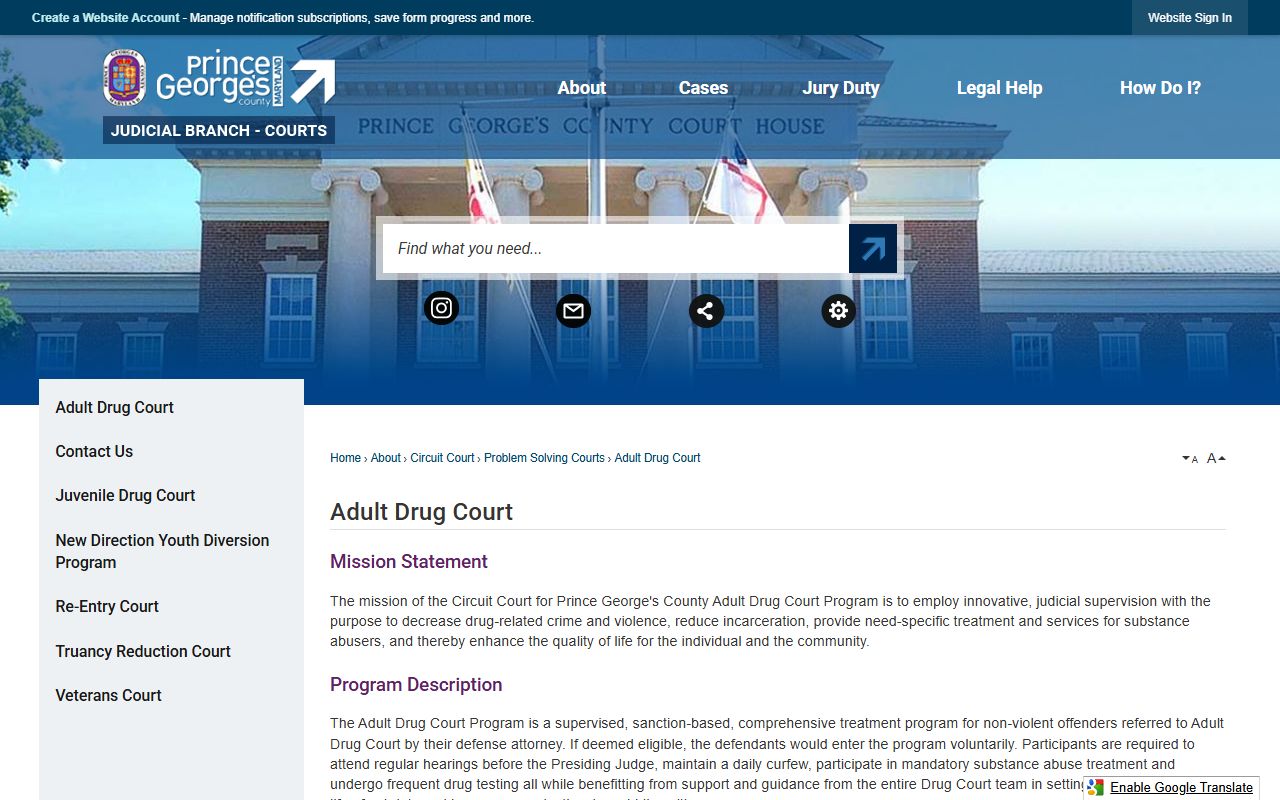
That source matters for criminal records because problem-solving court participation can add review hearings, sanctions, treatment-compliance entries, graduation, or termination events to a docket instead of a straight plea and sentence timeline.
How to Search Prince George's County Criminal Court Records
The main online access point is Maryland Judiciary Case Search at casesearch.courts.state.md.us. Maryland Courts describes Case Search as the public way to search case information from District Court and Circuit Court case-management systems. It is a summary portal, not the official paper or MDEC file. It may show party names, city and state, case number, date of birth when available, trial date, charge, disposition, and detailed case information, but documents, exhibits, transcripts, and certified copies must come from the clerk or approved court access channels.
- Start with Maryland Judiciary Case Search and choose a criminal search path or general inquiry path when offered.
- Search by case number if the citation, summons, warrant, notice, or attorney paperwork gives one.
- When searching by name, try the legal first and last name, initials, spelling variants, suffixes, and Prince George's County filters where available.
- Open the result and compare date of birth, city, court, case type, filing date, trial date, and party role before assuming it is the right person.
- Read the docket entries, charges, pleas, dispositions, sentence, bond activity, and future hearing dates, then contact the clerk for official copies.
If the criminal case is in Circuit Court, the Criminal Division is at 14735 Main Street, Room M1408, Upper Marlboro, MD 20772, phone 301-952-3344. The Circuit Court general number is 301-952-3318. District Court criminal matters may be at Upper Marlboro, 14735 Main Street, Suite 173B, phone 301-298-4000, or Hyattsville, 4990 Rhode Island Avenue, phone 301-298-4200. Mail requests should identify the case number, defendant name, document requested, requester contact information, and payment method if the clerk confirms a copy fee.
Maryland OPD's local office details are published at the Office of the Public Defender Prince George's County page.
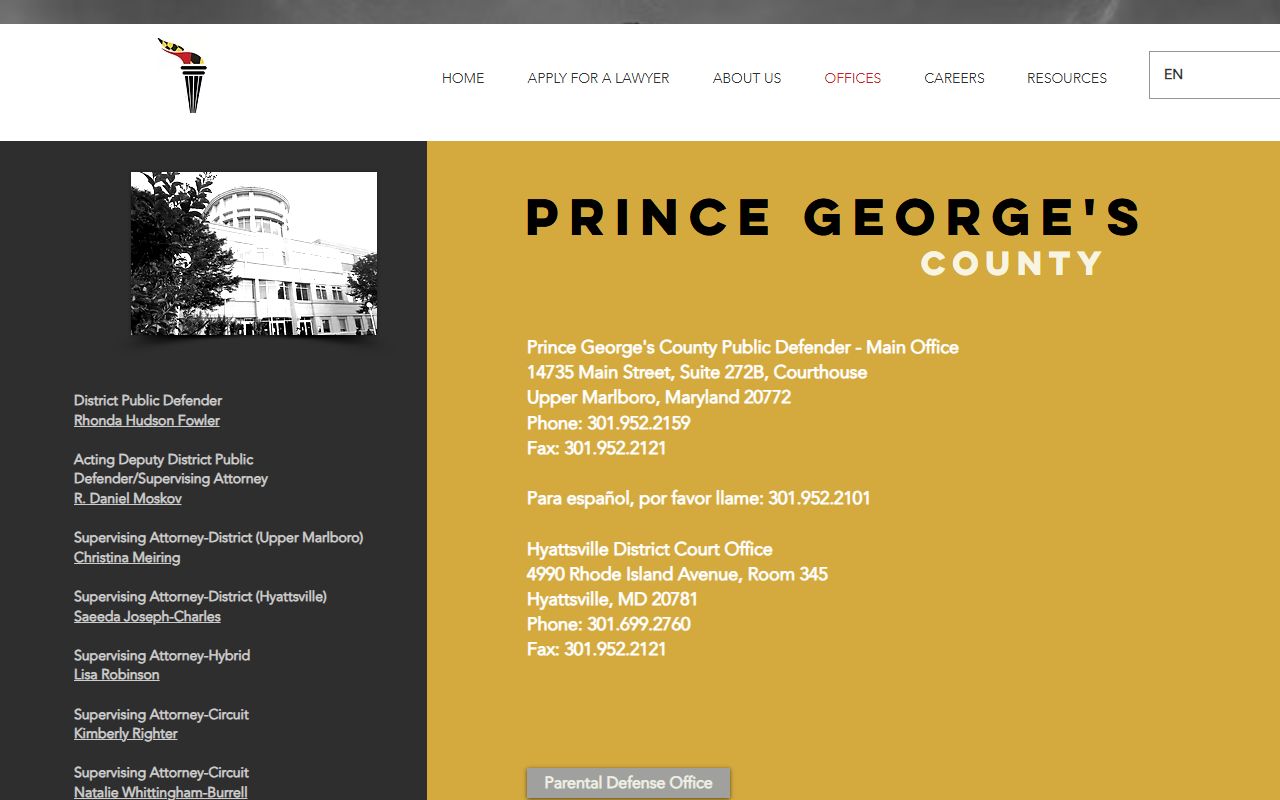
Defense representation can affect docket entries for bail review, preliminary hearings, motions, pleas, sentencing, modifications, and probation violation proceedings.
Stages of a Criminal Case
A Prince George's County criminal court file often starts with a charging document, citation, warrant, summons, information, or indictment. District Court may handle initial hearings, many misdemeanors, traffic crimes, and some felony preliminaries. Circuit Court handles felony prosecutions, jury trials, indictments, appeals from District Court, and major post-trial matters. The docket is the running log that ties those stages together.
Case flow: Charges Filed › Initial Appearance or Arraignment › Pretrial and Motions › Plea or Trial › Disposition › Sentencing › Probation or Post-Judgment Activity
| Stage | What Happens |
|---|---|
| Charging | A complaint, citation, information, or indictment identifies each alleged offense, statute, date, and defendant. The charge can later be amended, reduced, dismissed, or replaced. |
| Arraignment | Charges are formally presented and the defendant may enter a plea. Case Search may show the hearing date, court, counsel, and future scheduling entries. |
| Pretrial / Motions | Attorneys file motions, request discovery, address bond, subpoena witnesses, and ask for rulings. Continuances and status hearings appear as docket entries. |
| Plea or Trial | The case may resolve by plea, bench trial, jury trial, dismissal, nolle prosequi, acquittal, or stet. The final outcome should be checked charge by charge. |
| Sentencing | A conviction can lead to jail, probation, restitution, fines, costs, treatment, or suspended time. Probation violations and modifications can add later entries. |
The Circuit Court's Juvenile Drug Court information appears on the official Juvenile Drug Court page.
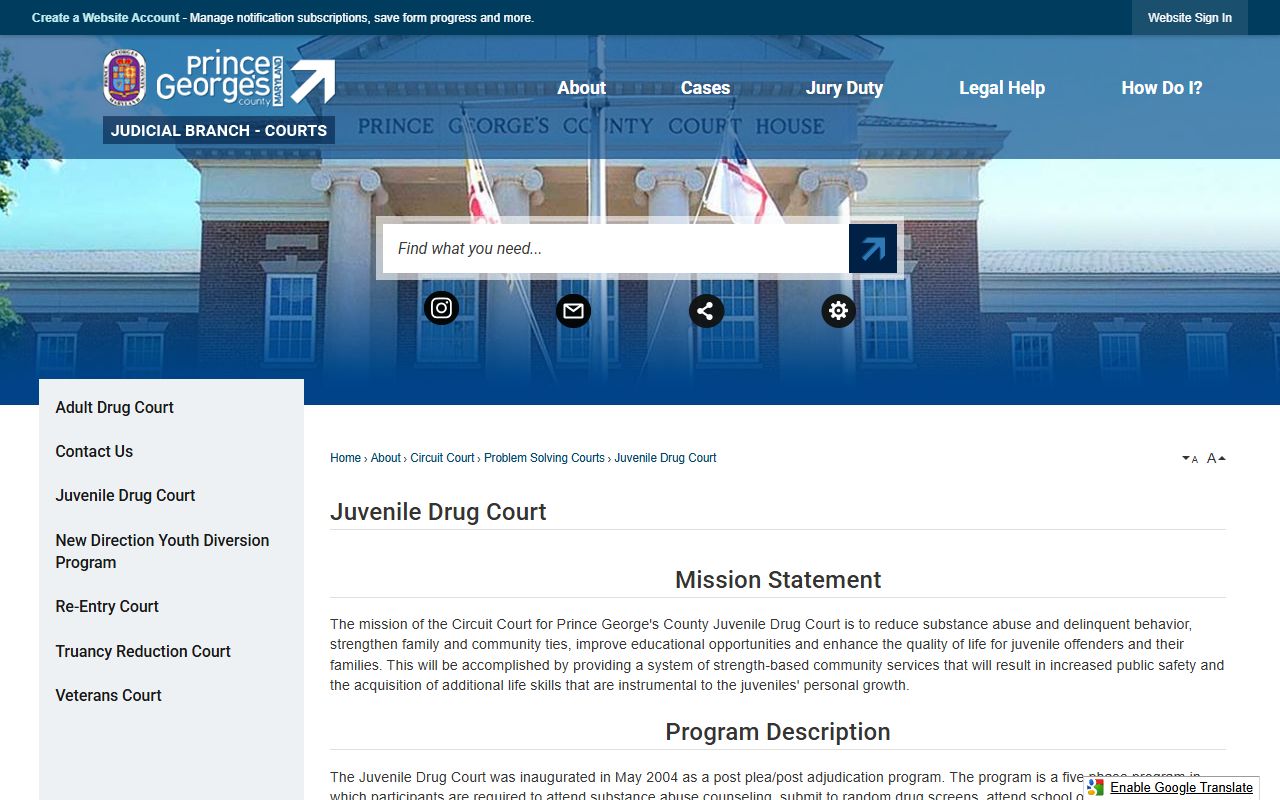
Juvenile proceedings are confidential under Maryland law, so the image supports court-structure context, not a public-search channel for juvenile criminal records.
What a Prince George's County Criminal Court Record Shows
Case Search and clerk files can contain different levels of detail. A public online summary may show the fields needed to identify the case and understand its current status, while the official file may include pleadings, orders, written motions, exhibits subject to access rules, and certified copies. Maryland's statewide MDEC implementation was completed on May 6, 2024, so electronic workflow now affects all Maryland courts, but public access remains governed by Maryland Rules 16-901 through 16-912 and related restrictions.
| Field | What It Shows |
|---|---|
| Case Number | The unique court identifier. Use it for the most precise search and for clerk copy requests. |
| Court and Location | Circuit Court for Prince George's County, District Court Upper Marlboro, District Court Hyattsville, or an appellate court if appealed. |
| Defendant | Name, party role, and sometimes city, state, or date of birth when the system displays those identifiers. |
| Charges | Charge description, statute, severity, arresting agency, charging document, warrant or citation reference, and amendments where public. |
| Docket Entries | Filings, notices, hearings, continuances, motions, orders, subpoenas, warrants, bond events, and disposition entries. |
| Plea | The defendant's answer to a charge, such as guilty, not guilty, or another plea entry recognized by the court. |
| Disposition | The charge-by-charge outcome, including guilty, not guilty, dismissed, nolle prosequi, stet, acquittal, or other court result. |
| Sentence | Jail, suspended time, probation, restitution, fines, costs, treatment, or other conditions imposed after conviction. |
Veterans Court eligibility is described by the Prince George's County Circuit Court Veterans Court page.
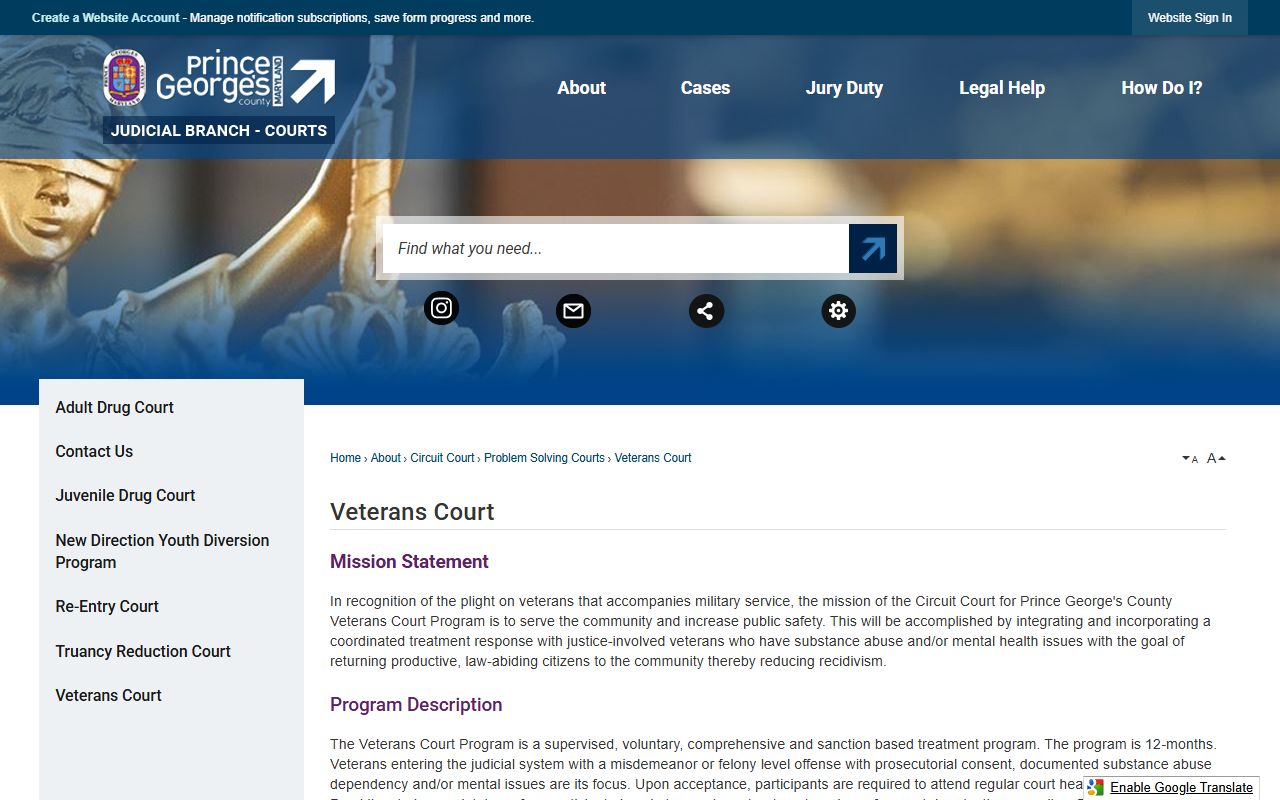
Veterans Court can produce supervision, treatment, status-review, compliance, and termination entries that should be read as part of the criminal court record.
Charges vs. Convictions
A charge is an accusation placed before the court. A conviction is a guilty plea, guilty finding, or verdict after the court process. Maryland criminal records can show charges that never became convictions because the State entered nolle prosequi, the court dismissed a count, the defendant was acquitted, a count became stet, or the prosecutor amended the charge. For that reason, a Prince George's County criminal case should be read count by count and date by date rather than treated as one simple result.
| Charge | Conviction | |
|---|---|---|
| Meaning | An alleged violation filed by law enforcement, a prosecutor, or grand jury process. | A guilty plea, guilty finding, or verdict entered by the court. |
| Record Stage | Appears near the beginning and can change through amendment or dismissal. | Appears after plea, trial, or other final adjudication. |
| Public Reading | Do not describe a person as convicted based only on a charge line. | Check sentence, probation, appeal, and post-judgment entries for context. |
Reading Dispositions and Sentences
Disposition is the court's resolution of a charge. Common Maryland terms include guilty, not guilty, acquittal, nolle prosequi, stet, dismissal with prejudice, dismissal without prejudice, and probation before judgment where applicable. Nolle prosequi means the prosecutor declined to proceed on that charge. Stet means an inactive criminal docket status that can later be reopened under conditions. A sentence should be checked separately from disposition because one guilty count can carry suspended time, active incarceration, probation, fines, restitution, treatment, community conditions, or post-sentence supervision.
The State's Attorney's Office is the prosecutor, not a district attorney. Prince George's County State's Attorney Tara H. Jackson leads the office at 14735 Main Street, Suite M3403, Upper Marlboro, MD 20772, phone 301-952-3500. The office handles criminal cases from minor traffic offenses to severe homicide cases, and its District Court Unit works in both Hyattsville and Upper Marlboro courthouses.
The New Direction Youth Diversion Program is documented by the Circuit Court's program page.
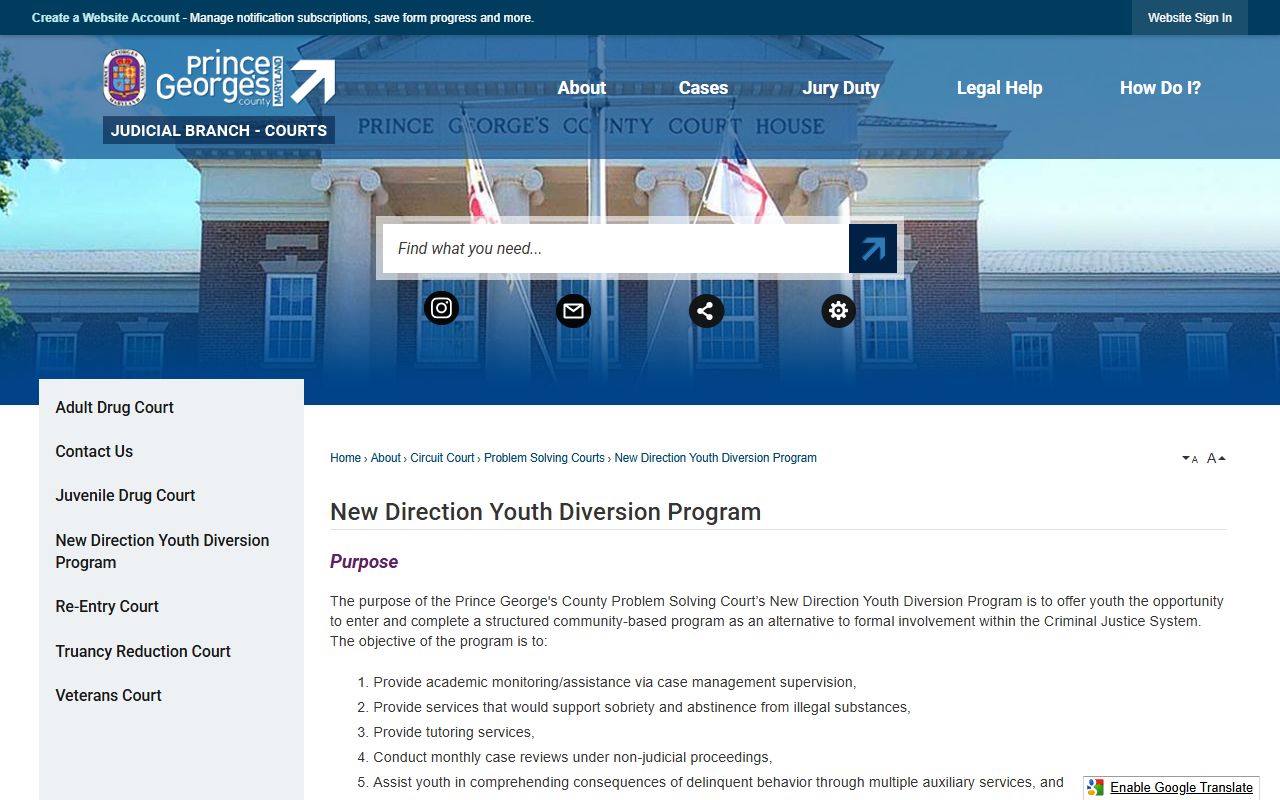
Because that program concerns eligible youth and juvenile-adjacent processes, public criminal searches should still respect Maryland juvenile confidentiality rules.
Sealed vs. Expunged Records
Maryland draws practical distinctions between records that are sealed or shielded and records that are expunged. Expungement removes qualifying police and court records from public view. Sealing or shielding restricts public inspection without necessarily destroying the underlying court record. A missing Case Search result does not prove the event never happened. It may mean the matter is sealed, expunged, shielded, juvenile, confidential, or no longer remotely displayed because of Maryland's non-conviction and cannabis access rules.
| Sealed or Shielded | Expunged | |
|---|---|---|
| Public Visibility | Hidden or limited from ordinary public inspection by rule, statute, or order. | Removed from public court and police record access after a qualifying order or automatic process. |
| Underlying Record | May still exist for authorized court, party, or agency use. | Treated as unavailable to the public, with limited statutory exceptions. |
| Maryland Authority | Maryland court access rules and case-specific orders can restrict inspection. | Criminal Procedure § 10-105 and § 10-105.1 cover qualifying expungement paths. |
Public Access to Criminal Court Records
Maryland judicial records follow Maryland Rules 16-901 through 16-912. Maryland Rule 16-903 is commonly cited for the general principle that court records are open unless a rule, statute, or court order restricts inspection. Agency records such as police reports, sheriff records, and corrections records are different from judicial records and are requested from the agency custodian under the Maryland Public Information Act.
Key Authorities:
Maryland Rule 16-901 starts the judicial-record access framework for paper and electronic court records.
Criminal Procedure § 10-105 authorizes expungement of qualifying police and court records.
Courts and Judicial Proceedings § 3-8A-27 makes juvenile police and court records confidential except as allowed by law.
The Maryland Judiciary overview at courts.state.md.us/courts/about explains the state's four-level court system.
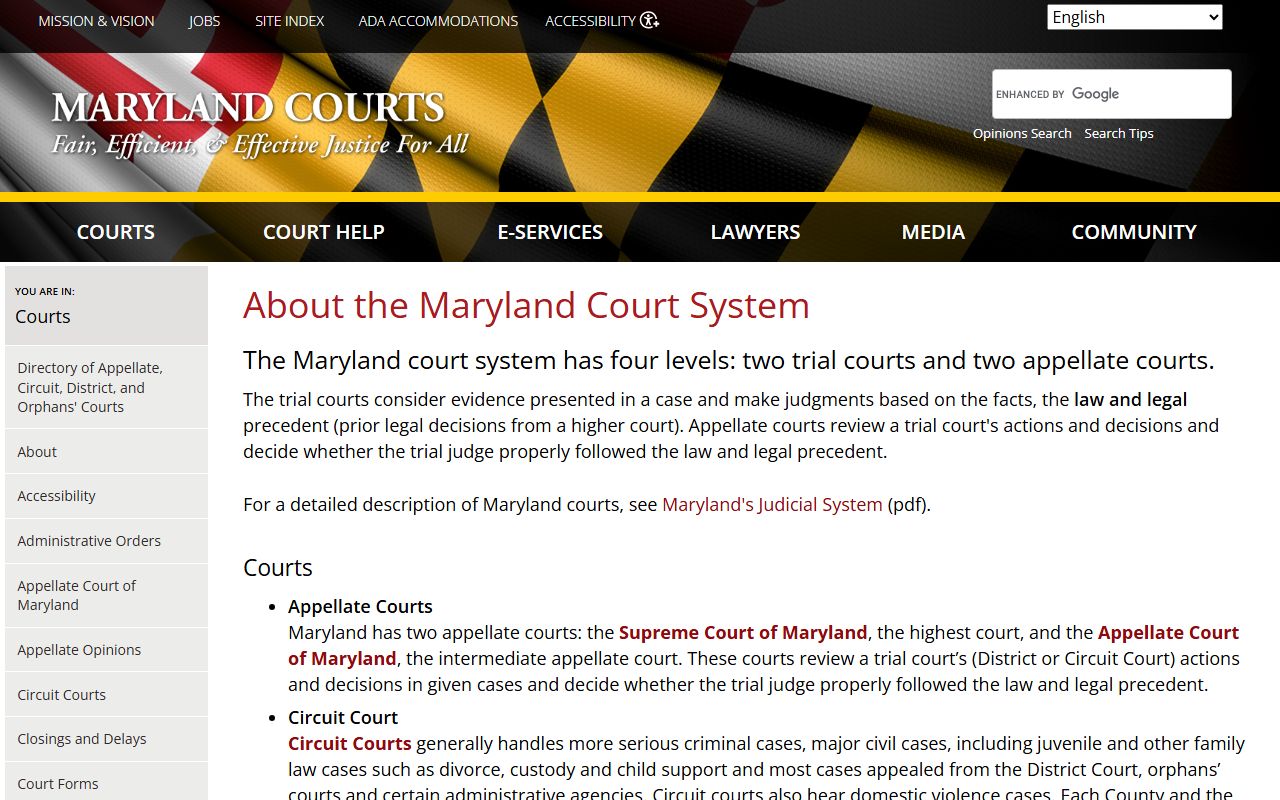
That hierarchy explains why Prince George's County criminal records may begin in District Court, move to Circuit Court, and then appear in appellate records if a final judgment is appealed.
Background Check Considerations
Case Search can help confirm public court activity, but it is not a regulated employment, tenant, credit, insurance, or licensing background-check product. Criminal records can be incomplete online because of remote-access limits, sealing, expungement, redaction, data timing, name variation, court location, or pending clerk processing. Any serious background decision should rely on legally compliant screening procedures and direct verification from the originating court or agency.
Important: This site is not a consumer reporting agency and cannot be used for FCRA-regulated screening decisions.
Restricted Criminal Court Records in Prince George's County
Restricted criminal records include juvenile records, sealed cases, expunged cases, confidential addresses, minor names, medical or mental-health attachments, protected financial information, and records barred from remote access by Maryland policy. Maryland Courts specifically limits remote display of certain criminal information, including charges ending in nolle prosequi, dismissal, acquittal or not guilty, stale stet outcomes after three years, certain possession of cannabis cases disposed before July 1, 2023, and pardoned cannabis-possession convictions. When a result is missing online, the next official step is courthouse inspection if the record remains public.
The statewide Office of the Public Defender describes its role at opd.state.md.us.

OPD representation may appear across arraignment, bail review, preliminary hearing, motion, trial, plea, sentencing, modification, and probation violation entries.